In the previous articles, the topics of the opening and the setup were laid out. Now it’s the main body’s turn. This is the largest component of the book, both in volume and in the events that happen inside it.
Generally, the main body is regarded as something big — a place where you can write whatever you want and not particularly worry about conventions and rules. But that isn’t the case. When writing the main body, you should already understand where you have to arrive. If we pull the camera back, so to speak, and look at the whole book, it becomes clear that the main body of the book is a route plotted across a large navigator’s display from the setup to the climax. This doesn’t have to be a clear vision of the specific peak scene that’s coming. But at the very minimum, you have to understand the idea — otherwise it’ll be entirely unclear where exactly you’re plotting your route to.
My Experience
When I started writing the rather specific book Not Like the Others, all I had at the start was a vision of how the strong of this world successfully use the things that matter to us. And, of course, a clear understanding that for them, these things are nothing more than instruments of influence and ways of making money.
The Way of Life was the realization of an idea: that everyone can have their own happiness — and that for many people, it will be an illusion imposed on them by others.
I didn’t see any climactic scenes in either book at the start, but I was already ready to write something. Of course, if a writer can see specific events and conditions they have to reach, that’s an outright superb situation. But this is fairly rare, which means most of the time you’ll have to settle for the basic idea.
The Train Concept
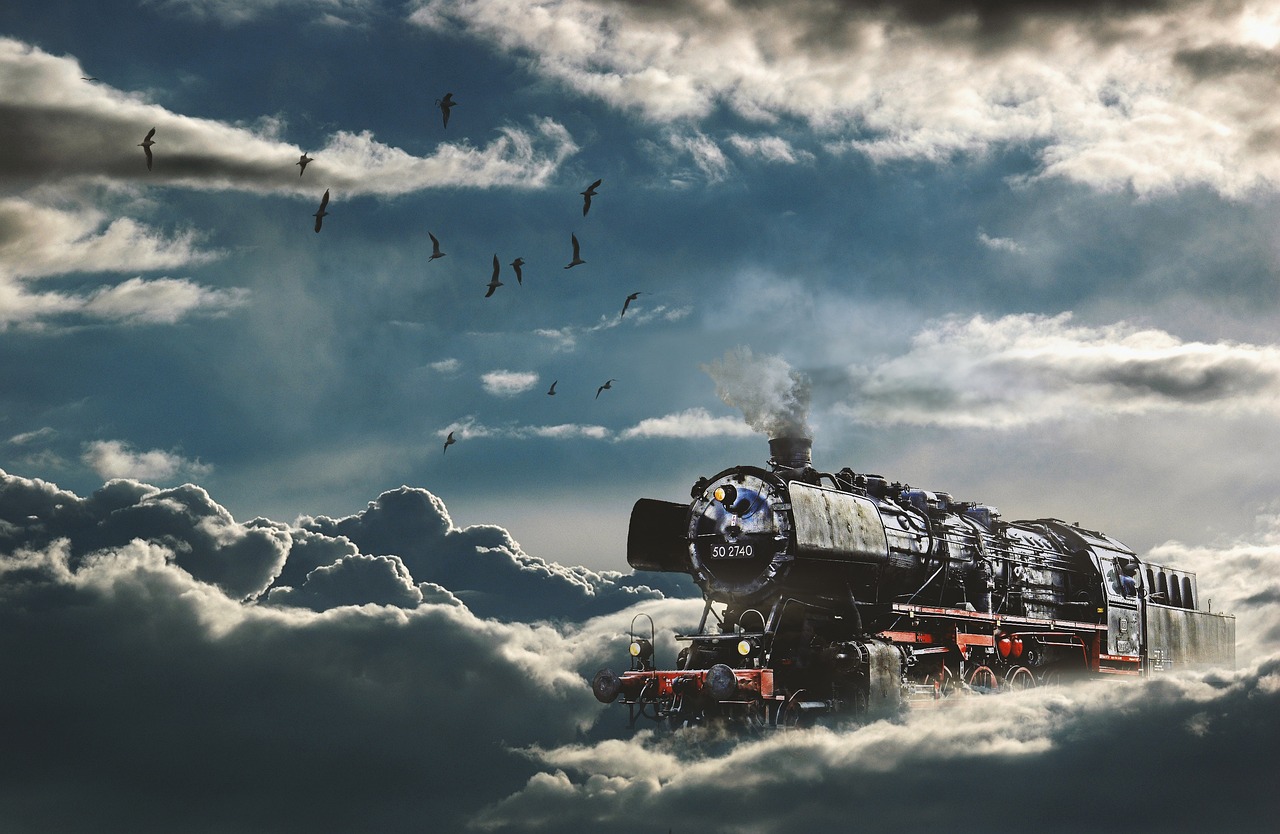
So, we plot the route — and we keep in our head the understanding that the metaphorical train, with its characters and events, will be carrying along one more passenger: the reader. The reader will move together with everyone else, taking no part in the action but giving it their attention. They have to arrive at the climax point as well, captivated by everything that’s happening — and that’s only possible if all of it has become something familiar and close to them. Otherwise, they may get off at the next stop.
How do you create such conditions? Let’s return to the concept of the train moving along its route, and transfer that to real life. What happens during the trip? At the start, the characters are revealed. One of them starts pestering everyone with his conversation, and we understand that there will be a lot of noise and unnecessary information coming from him.
Over there, another one has solemnly changed into his tracksuit, is eating chicken with hard-boiled eggs, and is quietly pouring himself vodka, gradually drifting into a state of mild stupor. Across from him sits a completely different person. A man in a business suit. He’s reading some intelligent book and wrinkling his nose at his neighbor’s fumes.
Everyone understands that, sooner or later, a conflict will inevitably arise between them. And it happens because life itself has revealed these characters to us — through their appearance, through their specific actions. We understand the motivation and the contradictions of these people in advance. And the fact that we’re traveling with them on the same train makes the future conflict interesting and close to us.
The First Piece of Advice. Appearance and Actions.
The same thing has to happen in the book. Here’s the route, here are the heroes. Create natural conditions for them. Bring attention to their appearance and their actions. You have to pick up what was created in the setup, develop it, and reveal your characters in such a way that they become familiar and logical for the principal passenger: the reader. They have to believe in your characters’ existence. To understand why they act exactly the way they do. And this is one of the main tasks of the main body.
Keep Moving! The Secondary Matters Too.
The main thing, however, remains arriving at the climax point. I’ll bring you back, once again, to the train analogy. To get somewhere, you have to keep moving. Once again, an obvious phrase — which we’ll transfer over to the book. It’s impossible to move from the setup to the peak of events in a single move. It’s a route. Winding and complicated. Some things have to happen outside the train as well. At the stations where it stops. On the rail-bed it travels along. Without anything superfluous. We have to depict exclusively what is going to keep moving along inside this book-train. Nothing extra. New characters have to enter into contact, at a certain stage, with the ones who’ve been in the book from the start. Or to create events that will continue to influence the plot.
Some passing character traveling along with the main heroes might speed up or develop the events. For example, by giving our passenger in the tracksuit a bottle of cognac. He has to start pestering the intellectual with an offer to drink — having earlier been refused, when the intellectual said he doesn’t drink vodka. Only cognac. From there, the man in the business suit will either refuse — which leads to a fight with the offended “athlete” — or, on the contrary, he’ll agree, and in the course of their drinking it will turn out there aren’t really that many differences between them.
The Idea Defines Everything.
Completely different developments — depending on the book’s underlying idea. If the book is about the gap between social classes and worldviews, then let them fight. If, on the contrary, the book is about how people have more in common than they think, then let them drink and find that common ground. In a book, things work the same way as in life. People with an emphasis on the negative find more conflict. Those, however, who approach things with a positive attitude find, accordingly, more positive interaction.
So, the next piece of advice. Fill your plot and your main body with events that will look real from the standpoint of the world you’ve created in the book. Let it be logical and clear for the reader. And let all of it correspond to the underlying idea. That way, when you arrive at the climax, you’ll be able to enter it naturally — without needing to overload the text with additional explanations and other harmful supporting devices.
The End of the Main Body. Only the Essential.
Moving on. We have the entry point into the main body, which was created by the setup. We have the middle, where the main body is its own master, while at the same time striving toward the union with the peak moment of the book. Remaining is the pre-climactic part, where we are about to burst into the climax itself.
What has to be here? And once again I’ll bring you back to the train. What happens along the way and toward the end of the trip? There are fewer and fewer passengers. Everyone who has played out their role has to disembark. All the events that, at different stages, were flowing in from various directions like streams into the train have, having done their work, to no longer be brought up.
The only difference from a real train is that you yourself will have to choose who, exactly, leaves the story — and who takes one of its central seats.
You, as a writer, have to clearly recognize: that’s it, only the main characters and the main thoughts remain. Everything else has to go, leaving behind the necessary memories and attitudes. We no longer need anything new — unless it’s the central idea of the book (something like the appearance of a figure who has been influencing, or could radically influence, everything, without breaking the plot).
The marker that the entry is ready is this: on stage are only those characters who carry enormous significance. And there are events present that are at their peak and at maximum temperature.
That’s the point at which the main body can be released. And this is almost the last concrete piece of advice.
Before transitioning to the climax, clear all the secondary characters off the stage. Reduce everything to the interaction exclusively between the main characters. Leave only those processes that carry high tension. From there, the climax will take its own course — and I’ll be writing about that in the next article.
That’s almost everything I’d want to say. I again don’t give a formula or an instruction, staying within the frame that you have to understand, not repeat. At the same time, what could be defined more or less concretely, I haven’t sidestepped.
An Image Built by Life
Finally, I’d like to return once more to the train, which I used in order to make it easier to convey the information. A simple image which managed reasonably well to convey complex information — drawing both on my own life experience and on the experience of those who will be reading this article. The simple logic of the everyday, set in parallel with the creative process.
Things like this are remarkably effective, because they’re grounded in something each of us has already lived through. They’re grounded in our experience.
This is an example of something very important for the writing of books. Even if you’re going to be writing about extraterrestrial beings, you’ll be using, first and foremost, the knowledge and the experience available to you. It won’t be information from nowhere. Any invention will have its source and its roots in real life.
That’s why the last piece of advice for you is this: find what you want to write about, first and foremost, in your own experience. Draw parallels. Find what’s shared. Then you’ll never have problems with the realness of your content. And you’ll never wander off to write about something that’s foreign and incomprehensible to you.
The reader feels falseness better than any lie detector. And you won’t fool yourself either.
— I write fiction on commission. If you have a story you want to see told, here’s how we can work together. More on writing and the craft of books — in the blog.
Vasyl Kovalchuk, 30.04.2026